

Abstract Authors
Emmanuel Tapiwa Sero - Department of Biotechnology and Food Science, Durban University of Technology
Santhosh Pillai - Department of Biotechnology and Food Science, Durban University of Technology
Abstract Description
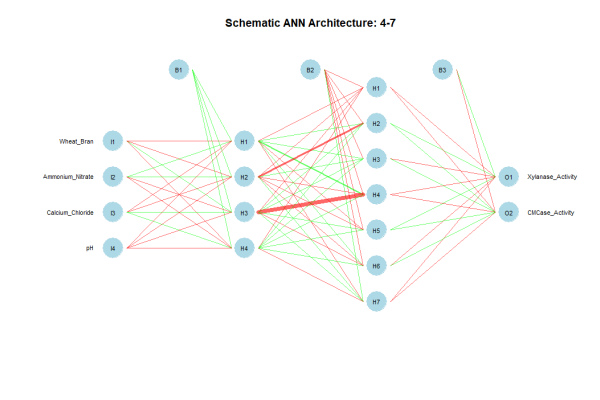
The optimised production of holocellulolytic enzymes is essential for efficient saccharification and valorisation of lignocellulosic biomass into bioenergy and biochemicals. In this study, a unified multi-output artificial neural network (ANN) modelling approach was applied to predict and refine the optimisation of Streptomyces-derived xylanase and CMCase (endoglucanase) activities under varying nutritional and physicochemical fermentation conditions. Four variables, namely wheat bran concentration, ammonium nitrate (NH₄NO₃), calcium chloride (CaCl₂) and pH, were used as model inputs, while xylanase and CMCase activities were treated as outputs. Data were normalised and partitioned into training and testing sets (80/20). A feedforward multi-output multilayer perceptron (MLP) was trained in R using the neuralnet package with backpropagation-based optimisation and multiple network architectures (3–7 neurons, up to two hidden layers) were systematically screened. Model performance was assessed using enzyme-specific R² values and a combined weighted accuracy metric (R²_weighted). The best-performing ANN topology (4–7) achieved strong predictive performance (R²_weighted = 0.96), supported by good agreement between standardised actual and predicted values and unbiased residual distributions. Feature-importance analysis using Olden’s method indicated that NH₄NO₃ (negative net contribution) and CaCl₂ (positive net contribution) were the dominant drivers influencing the predicted activities of both enzymes, while pH showed moderate influence and wheat bran contributed least within the evaluated design space. ANN optimisation refined the response surface methodology (RSM)-derived optimum, improving xylanase production with a predicted activity of 9.18 U/mL compared with 8.50 U/mL under RSM. Experimentally, ANN-refined conditions improved validated xylanase activity to 8.49 ± 0.10 U/mL compared with 7.90 ± 0.11 U/mL at the RSM optimum (~7.5% increase), while CMCase activity remained comparable. Overall, these findings demonstrate that multi-output ANN complements RSM frameworks by improving non-linear multi-response modelling and refining fermentation optimisation for enzyme-driven biomass saccharification.