

Abstract Authors
Jwalane Sephiri - Division of Medical Microbiology, University of Cape Town
Lynthia Paul - Division of Medical Microbiology, University of Cape Town
Brian Kullin - Division of Medical Virology, University of Cape Town
Abstract Description
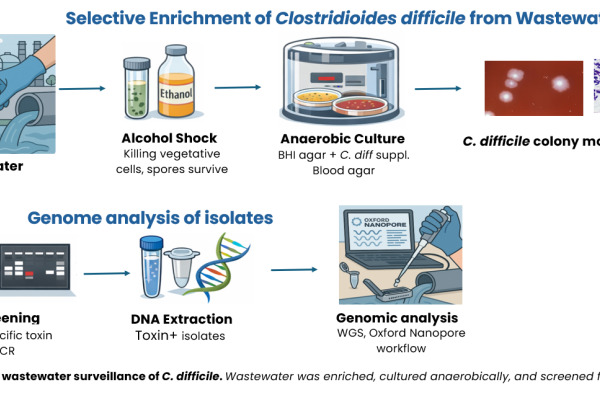
Clostridioides difficile is a spore-forming, toxigenic bacterium traditionally associated with healthcare settings but increasingly recognised as an emerging community and environmental concern. This study applies a One Health perspective to investigate C. difficile in treated effluent wastewater, assessing its potential role in environmental dissemination and community exposure risk. Treated effluent, while reduced in microbial bioburden, remains a reservoir for resilient microbial spores that survive wastewater processing, making it a valuable environmental source for detecting spore-forming pathogens, such as clostridia and C. difficile. Effluent samples, obtained from the local municipality, were processed using the selective enrichment medium CCMB-TAL (Cycloserine Cefoxitin Mannitol Broth with Taurocholate and Lysozyme), enhancing recovery of C. difficile. A total of 51 putative C. difficile isolates were obtained. Molecular confirmation was performed using PCR targeting the tpi housekeeping gene, a species-specific marker for C. difficile, as well as PCR targeting the tcdA and tcdB major toxin genes and cdtAB binary toxin genes. Currently, confirmed isolates are being characterised further by antimicrobial susceptibility testing to inform on resistance phenotypes in isolates originating from community settings (as opposed to hospitalised patients) and will undergo whole genome sequencing to determine strain diversity, antimicrobial resistance traits and virulence potential. The detection of C. difficile in treated effluent highlights the resilience of spore-forming microbes against wastewater disinfection practices, as previously demonstrated in other studies. In light of this, wastewater is to be regarded as a reservoir contributing to community exposure. Distinguishing environmental, hospital-associated, and community-associated strains will track emerging ribotypes and identify resistance patterns that may influence clinical outcomes. This work underscores the value of wastewater surveillance as a complementary early warning system to infections circulating in communities. By integrating environmental microbiology, molecular typing, and One Health principles, this study will contribute knowledge leading to a broader understanding of C. difficile transmission at the human–environment interface.