

Abstract Authors
Enriquay Smith - Department of Biotechnology, University of the Western Cape
Augustine Daniel - Department of Biochemistry, Federal University of Technology
Marshall Keyster - Department of Biotechnology, University of the Western Cape
Ashwil Klein - Department of Biotechnology, University of the Western Cape
Abstract Description
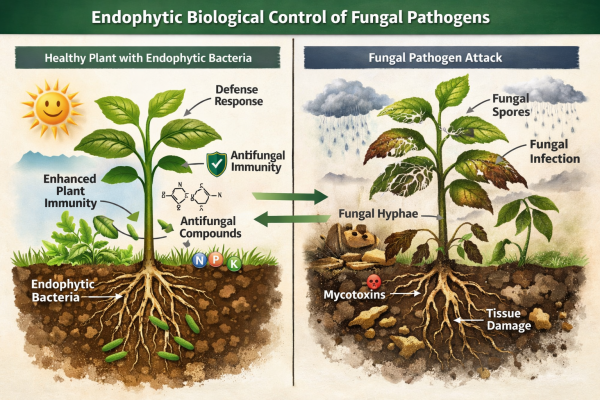
The reliance on chemical fungicides for crop protection has raised environmental and health concerns, prompting the need for sustainable and eco-friendly alternatives. Biological control, using antagonistic microorganisms like Paenibacillus terrae B6a, offers an eco-friendly approach to managing disease causing phytopathogens. The objective of the study was to assess the efficacy of P. terrae B6a as a biocontrol agent against Fusarium proliferatum PPRI 31301, focusing on its in vitro antagonistic activity, its impact on fungal morphology and enzymatic content, and its ability to mitigate pathogen-induced stress in maize plants. In vitro antagonistic activity of B6a against F. proliferatum was carried out using standard protocol. In planta assay was carried out by bio-priming of maize seeds with 1 × 10⁶ CFU/mL of B6a and infected with F. proliferatum for 7 days. Biochemical, enzymatic and antioxidants activities of bio-primed maize roots under F. proliferatum infection was carried out using spectrophotometric methods. In vitro antagonistic assays using dual culture and intracellular crude metabolites inhibited 70.15 and 71.64 %, respectively, of F. proliferatum. Furthermore, B6a altered the morphology and mycelia structure of F. proliferatum under high resolution scanning electron microscopy (HR-SEM). This was supported by an increase (p < 0.05) in the chitin contents (48.03 %) and a decrease (p < 0.05) in the extracellular polysaccharide content (48.99 %) and endo-β-1,4-glucanase activity (42.32 %).